
Contain the moment.
A concave, overlapping panel enclosure is designed to guide fluid downward and help reduce splash outside the target area.
Discover the ORBO concept, its evolving mechanism, and a family of ideas for home, growing families and life on the move.
Product concepts in development · Private showcase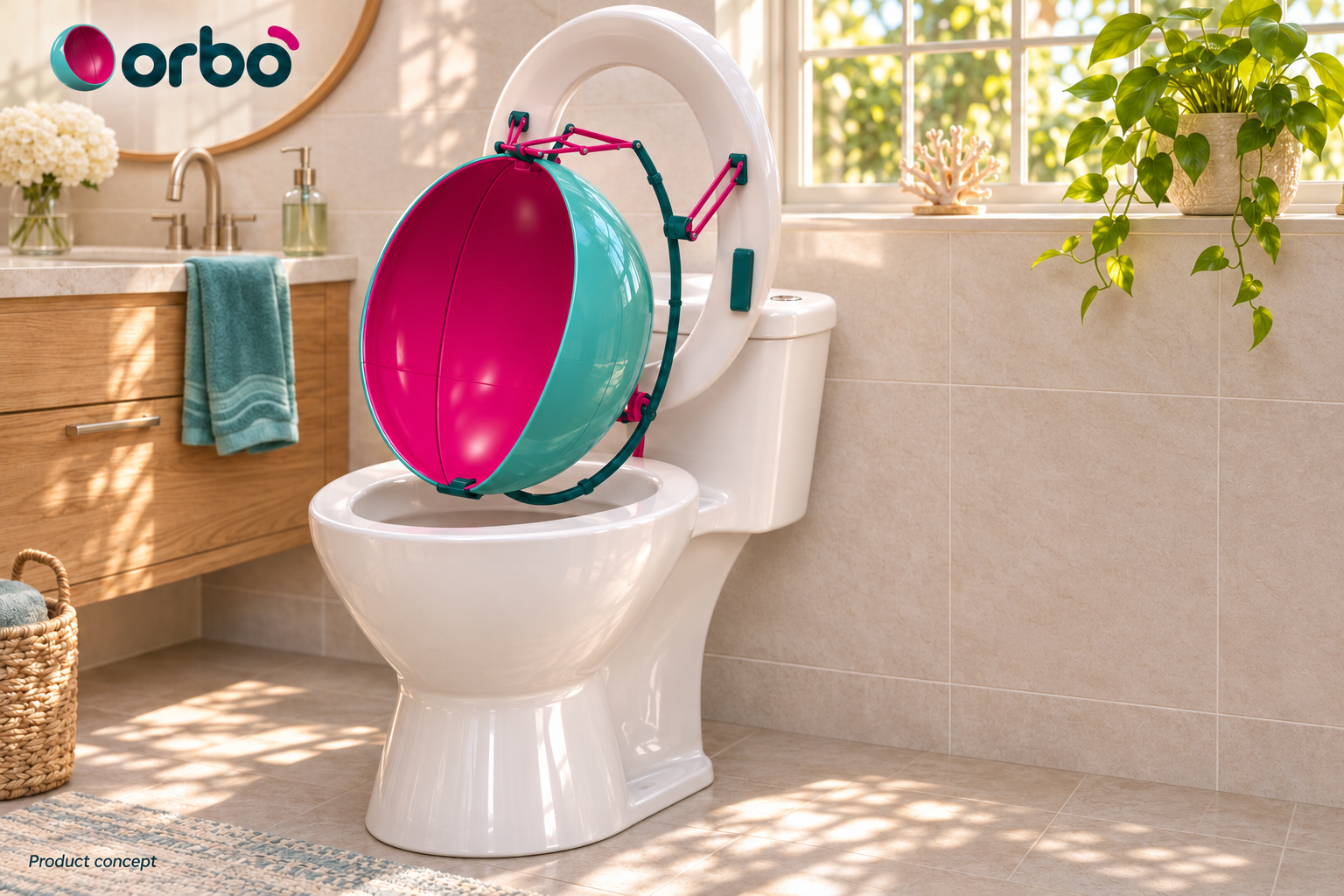
One toilet. A new possibility. ORBO explores a curved enclosure that rises with the seat, helps direct fluid into the bowl, and tucks away for everyday seated use.
From URI to ORBO · Product in developmentStanding use and seated use ask different things of the same toilet. ORBO brings a more enclosed target into that existing space, then makes room for the next person. The core idea is simple: adapt the fixture to the moment.
A concave, overlapping panel enclosure is designed to guide fluid downward and help reduce splash outside the target area.
V15 uses a hinge-driven cam drum, three Bowden cables and a cradle to coordinate the four panels. The mechanical deployment requires no batteries.
The four panels nest beneath the seat as the mechanism returns. The seat opening remains clear in the V15 reference geometry.
Benefits shown are development objectives. Splash control, clearance, fit and durability require validation on working prototypes.
Four enclosure panels and an open bottom drain path work together. Explore the proposed sequence below.
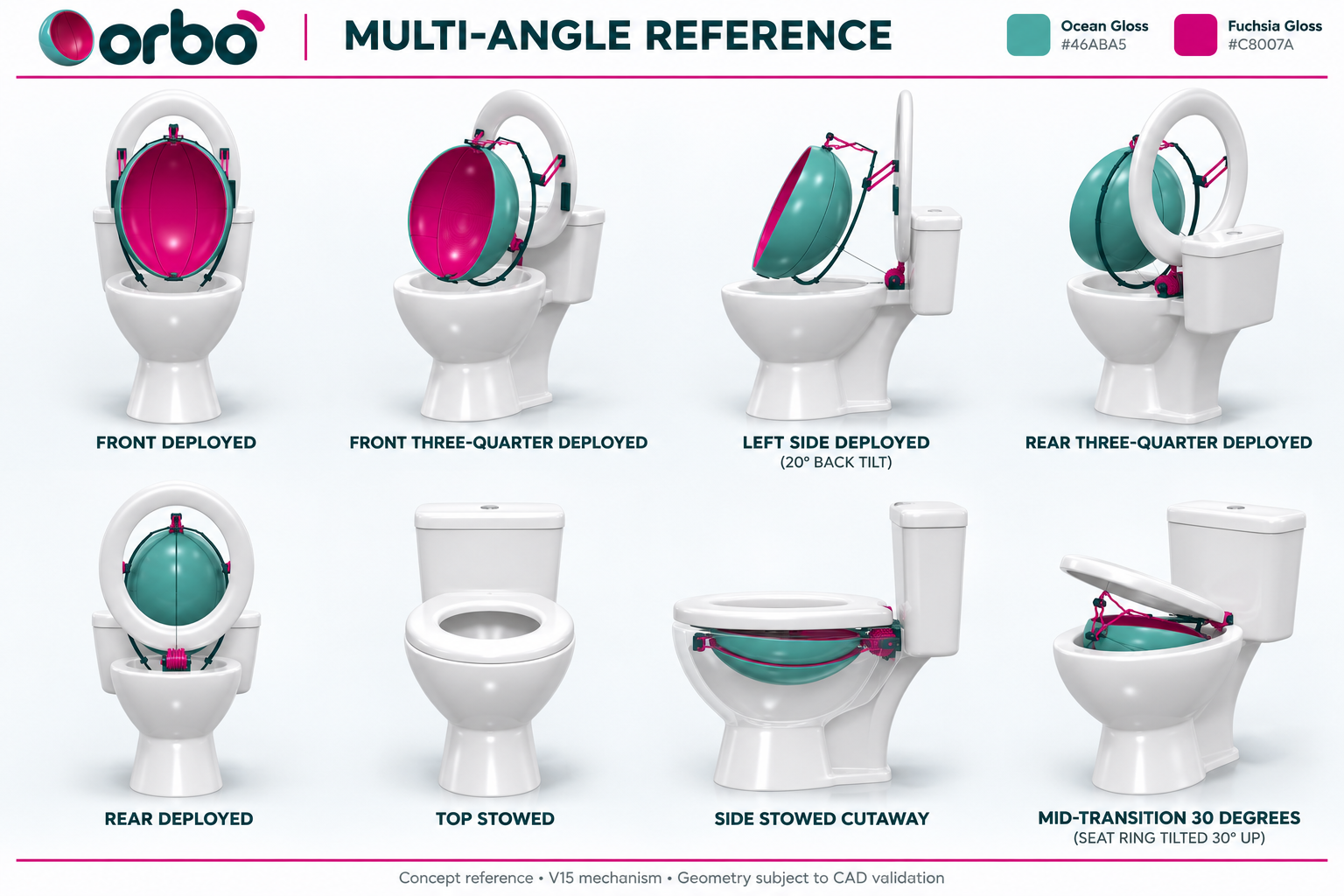
With the seat at 0°, the four-panel orb stows beneath the seat. Only the inner walls of panels 2 and 3 may be visible through the opening. Rest pads support the mechanism near full stow.
Illustrative reference, not a validated kinematic simulation. Select the image to enlarge it. PRO rinse timing will be developed separately from the passive seat motion.
From Petal's simple wings to ORBO's nested enclosure, each study explores a different way to make containment appear only when needed.
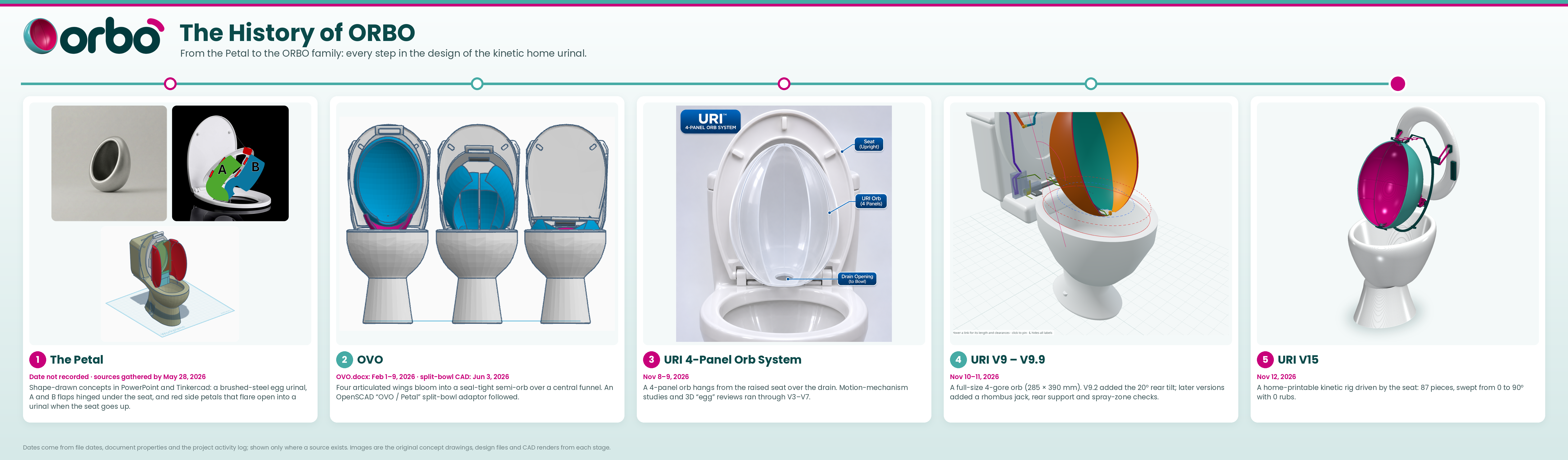
Original development imagery. The timeline follows concept sequence; calendar dates are not assigned.
Two seat-mounted side wings and a rear shield explore a more contained standing-use area, then retract toward the bowl sides.
An oval opening, two upper extension arms, split back panels and a front support explore deployment from a face-down stow position.
Four curved panels gather into an open-front orb. V15 coordinates a front jack, rear sling and cradle tilt through three Bowden cables.
PRO explores powered rinsing. JR considers smaller users and child potties. GO explores compact, shared travel facilities.
Earlier mockups reproduced from the original URI document provide a direct view of the development history.
Explore the proposed range. Each variant has its own engineering, usability and fit requirements.
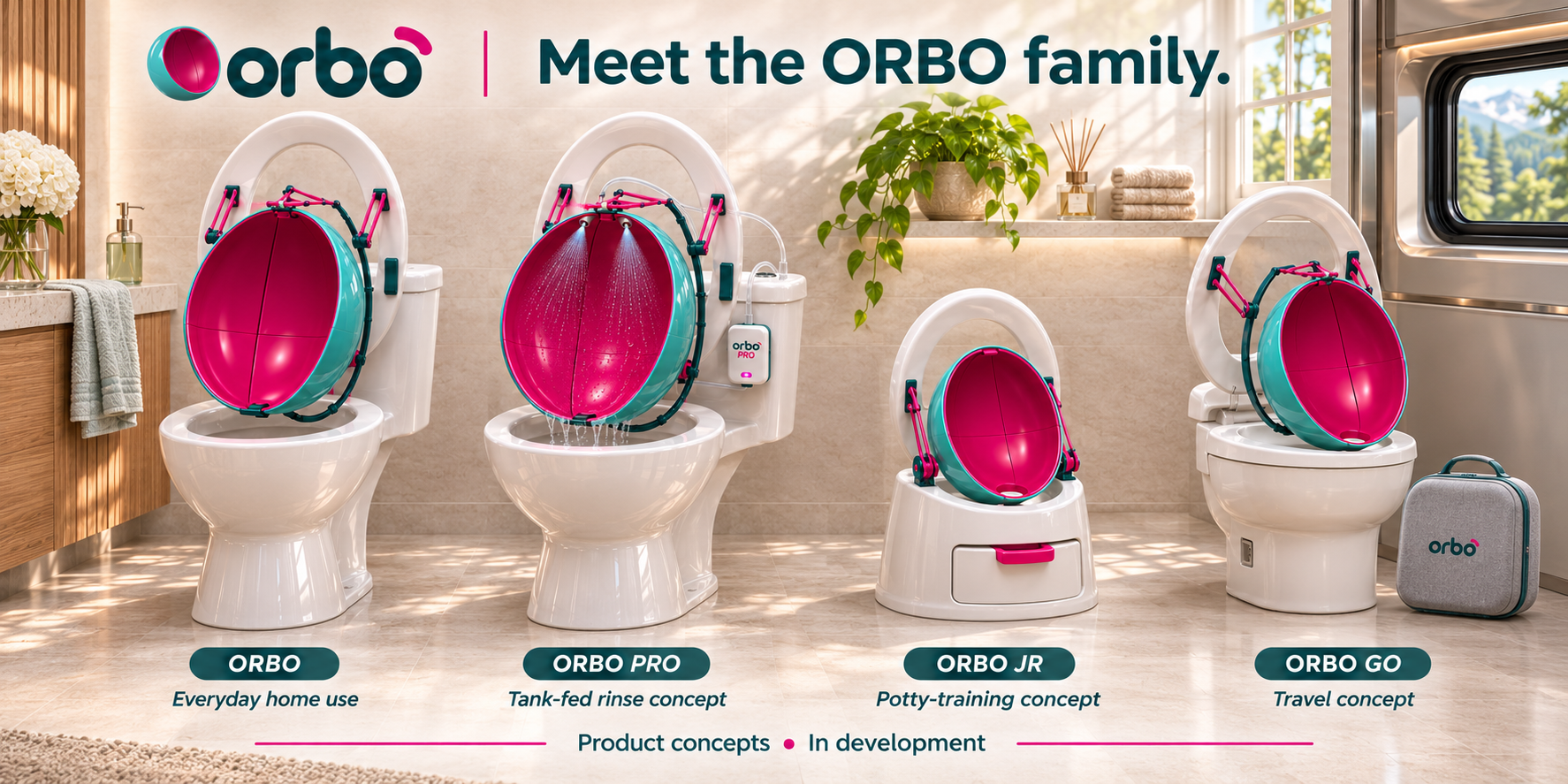
The mechanical foundation: a seat-responsive enclosure with four curved panels and an open bottom drain path.

A proposed electric pump sends clean water to an upper spray rail to rinse the enclosure interior.
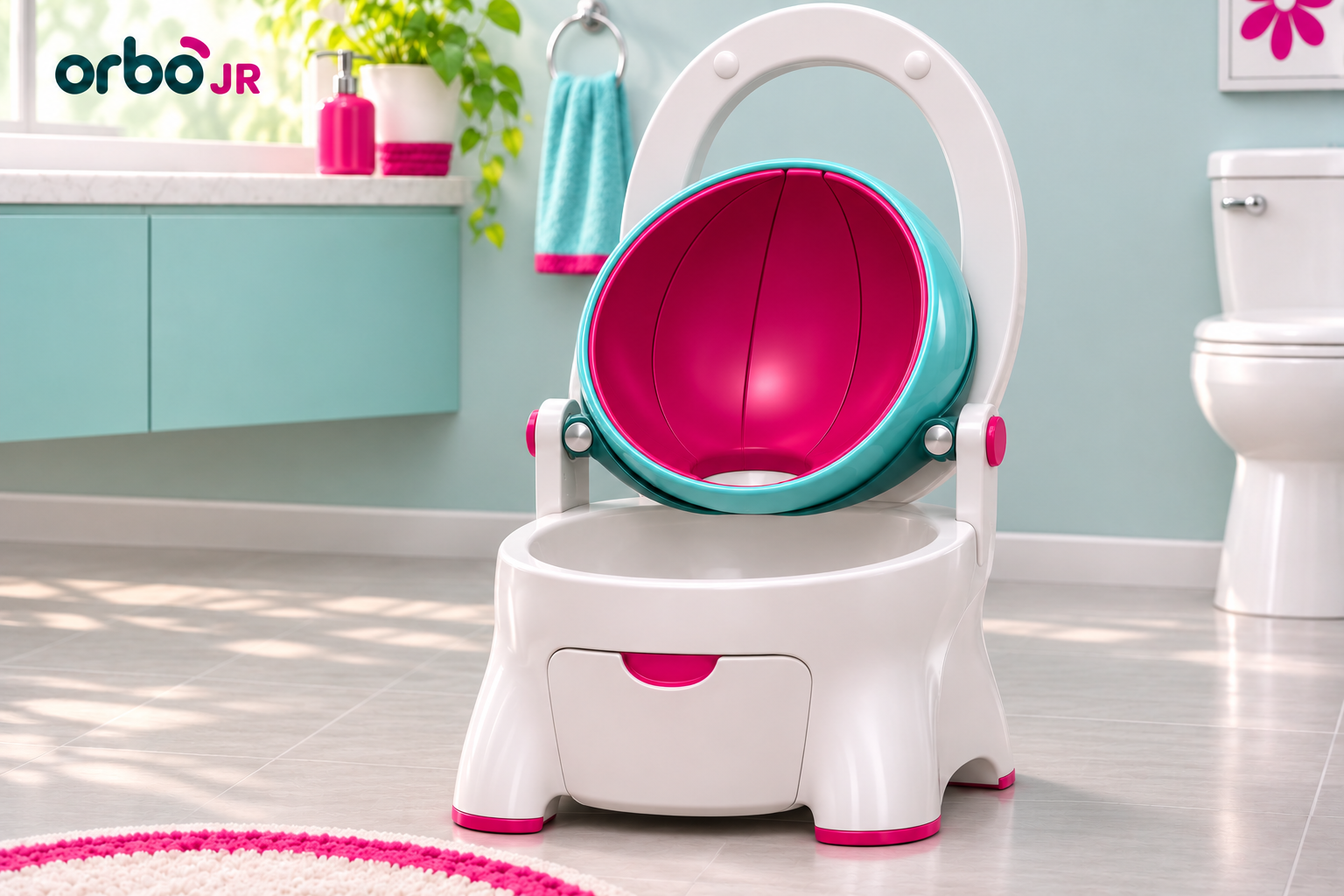
A child-scale exploration in two formats: a standalone potty urinal or an enclosure added to a compatible child potty.
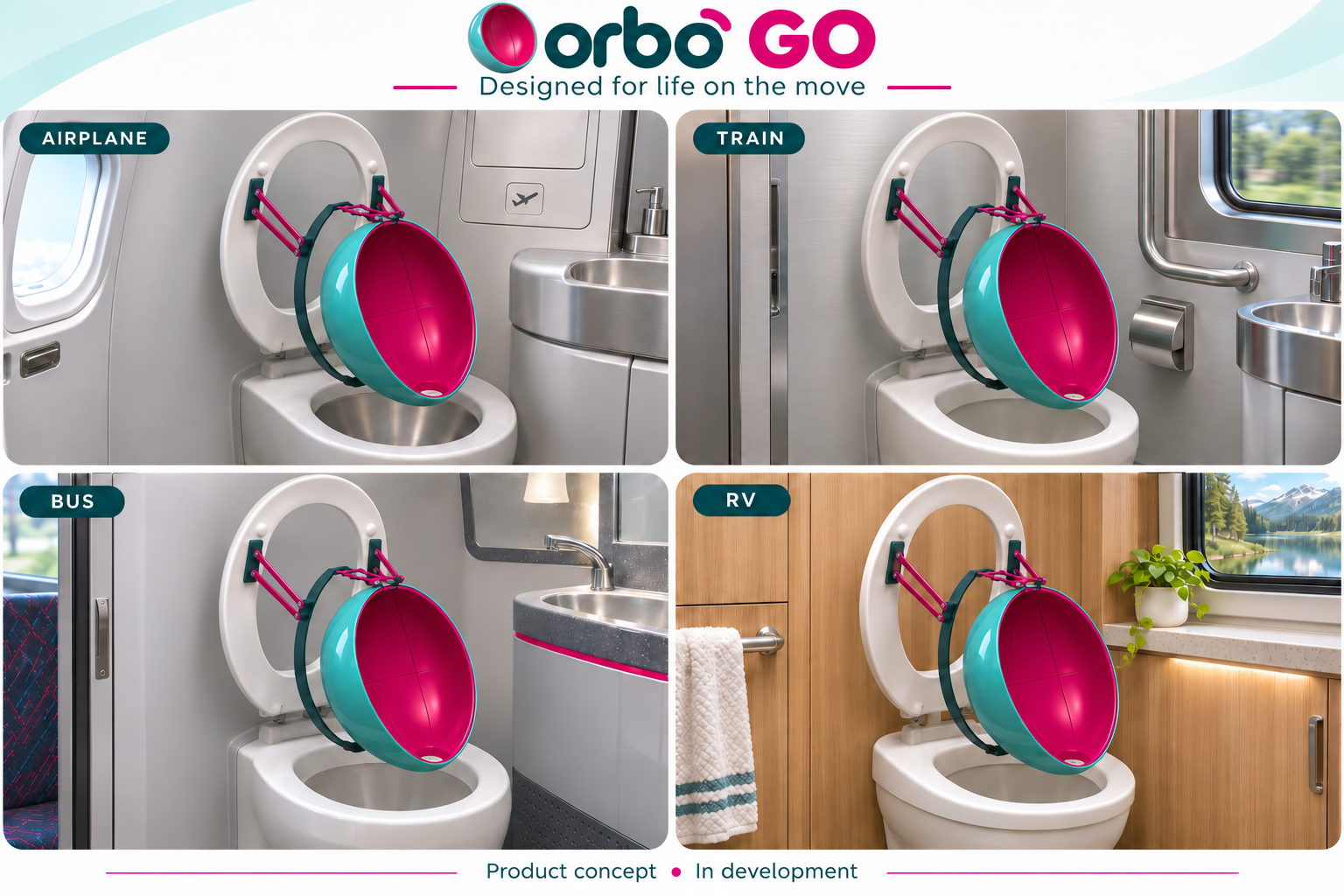
A compact adaptation for places where a small number of toilets serve many users.
PRO adds a proposed pump-assisted water circuit to the core enclosure. The aim: rinse the inner surfaces and carry residue toward the bottom drain.
The current render shows an intake line retrieving water from the toilet tank. Water-source isolation, backflow protection and tank compatibility require engineering review.
A battery-powered micro-pump sits in an external enclosure. A narrow hose carries water toward the top of the orb.
Inward-facing fan nozzles distribute water down the concave panels. Spray coverage and flow remain to be tested.
Rinse water follows the concave inner shell to the bottom outlet and falls directly into the toilet bowl.
A manual rinse button is the simplest concept. Seat-position-triggered rinsing could follow after the spray path, timing and containment are validated.
A rinse does not replace regular cleaning or establish disinfection. Water volume, noise, battery endurance, electrical protection and plumbing compatibility have not been verified. The render is not an installation guide.
JR brings the enclosure idea down to child scale, with a wide, approachable opening and a lower target position.
A low independent unit with a stable base and removable collection container, intended for supervised potty training.
A small enclosure designed around compatible child portable potties, guiding fluid into the existing collection bucket.
Stability, reach, finger clearance, material selection and cleaning access need dedicated child-safety testing. Adult supervision remains essential. No age rating or universal potty compatibility is claimed.
When one or two toilets serve a whole cabin, carriage or group, every usable inch matters. GO explores a compact enclosure that can return the fixture to seated use.
GO would require dedicated mounting, positive stow retention and access for cleaning. Vacuum, cassette and holding-tank toilets need separate clearance and waste-path reviews.
These mockups explore the use case. They do not establish vehicle compatibility, operator approval or transport certification. JR and GO are separate concepts for different users and settings.
| Concept | Intended setting | Main distinction | Key development work |
|---|---|---|---|
| ORBO Standard | Home bathroom | Passive seat-linked enclosure | Panel motion, bowl clearance, fit and splash testing |
| ORBO PRO | Home / selected shared fixtures | Electric pump and upper spray rail | Rinse coverage, power, water supply and drainage |
| ORBO JR | Supervised child potty training | Standalone or child-potty add-on | Stability, reach, child safety and collection access |
| ORBO GO | Transport / portable facilities | Compact fixture-specific adaptation | Retention, servicing, waste-system compatibility and approvals |
ORBO and the PRO, JR and GO variants are concepts in development. Pricing, launch dates and final configurations have not been announced.
V15 uses exactly four curved panels: front panels 1 and 4 and rear panels 2 and 3. Liquid drains from the bottom of the shell directly into the bowl. There is no separate fifth catch funnel in V15.
Standard is intended to use passive mechanical deployment. PRO introduces an electric pump for rinsing; that does not mean the enclosure itself must be motor-driven.
PRO proposes a water rinse for the interior surfaces. Cleaning and disinfection performance have not been established, and regular manual cleaning would still be necessary.
No universal fit is claimed. Bowl shapes, seat geometry and waste systems differ. Each configuration needs prototype testing, and transport uses require appropriate operator and regulatory review.
The new images are generated concept visualizations. The original CAD archive is labeled separately. The position infographic explains the intended sequence rather than proving the mechanism.
Explore every family version, the V15 motion sequence, care, design details and development priorities in the illustrated reference guide.
Download the reference guide ↓Explore where ORBO began, how it could move, and what a more adaptable bathroom experience could become.
Revisit the evolution ↑